


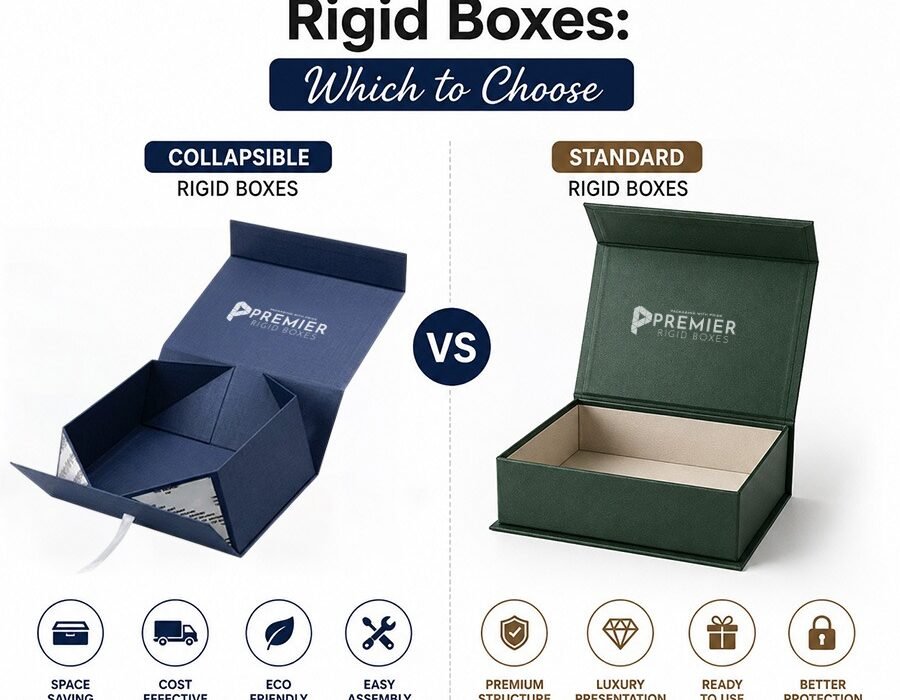
Both boxes have exactly the same high-quality appearance, but they are implemented in very different ways. One is ready-to-use, and the other is flat, which saves money. They are both good and bad, but for different reasons. If you’re looking for a new box for your mail, here’s the difference between collapsible and standard rigid boxes, plus tips for picking the right box.
They Look the Same, They Work Differently
Begin with their common ground, as that’s the big one. When put together, no customer will be able to distinguish between them.
They both feature thick boards with printed paper; they are solid and high-quality, and they both look great when presenting a product. The only difference is that a normal box remains stable in its shape, and a collapsible box remains flat until opened.
These are the qualities that the two share:
- All top-quality materials.
- The same solid quality.
- The same final appearance.
The difference is that, since the customer experience is the same, it depends on what happens before the box arrives.
Standard Rigid: Available to use
Think about the basic box initially. The primary benefit is its simplicity, as it comes all packed and ready to fill.
This has no assembly step. The boxes arrive pre-built, so you can pack products straight away with no extra labor. That’s very helpful for brands that are filling boxes by hand or in small quantities. The drawback of a formed box is that it occupies the full capacity of the box for shipping and storage.
Use a standard when you:
- Desire boxes to fill.
- Handfill or fill in small runs.
- Value convenience over space savings.
If you’re looking for simplicity, then standard rigid is the obvious option.
Collapsible Rigid: Designed to Save Space:
Now the fold-up feature. The biggest benefit is that it folds flat, which helps to save on shipping and storage costs.
A rigid box that folds up into a compact flat shape when put in a shipping carton and stores flat when not in use. This results in reduced freight costs and storage space. The cost is a bit higher due to an assembly step: each box must be folded into shape before it’s used. That’s generally more than counterbalanced by savings for volume sellers.
A collapsible rigid is good for when you:
- Ship in bulk or store in bulk.
- Seeking decreased freight expenses.
- Have limited storage space.
Shipping and storage are also important considerations if reducing an assembly step isn’t critical to your project.
The Assembly Question
This is the one aspect that many purchasers look into. A standard box doesn’t collapse, but it should be collapsible, so it’s important how you pack it.
Fill a few hundred boxes, and it takes moments to fold each one, with little notice taken. It is a small step that can be many thousands if done by hand. It is often simple to perform this in automated or higher-volume operations, and it can be felt in smaller-team operations. This collapsible box shrinks for shipping and requires a bit of assembly.
When deciding on an assembly step, take into account:
- How many boxes do you fill up?
- If hand packing is done.
- The cost to you of labor time.
For most brands, the folding is trivial. Consider the question carefully for some time before making a decision.
The Cost Comparison
Consider the total cost, rather than just the box price. If shipping and storage costs are added, the two can have different prices.
Boxes can cost the same, but a fold-up box saves on freight and storage space over its lifespan. A standard box incurs no assembly cost but has higher shipping and storage costs. When you’re considering a box, the comparison is more complete than the sticker price: box price + shipping + storage + any other assembly labor needed.
To compare the real cost, add up:
- The box itself.
- Shipping & Storage price.
- Any assembly labor.
For large volumes, collapsible is likely to be the winner, but for small volumes, standard may be the winner.
Which Suits Your Volume
Take your size into account, as it is very inclined toward one answer. The most important factor in this choice is volume.
Standard rigid is more often the better option for small runs, where the shipping savings are relatively small, and the convenience typically becomes a more significant factor. Collapsible boxes are ideal for large runs, as they provide additional savings while remaining reasonably quick to assemble (scale is based on the number of boxes). The more boxes you have to move, the more value a collapsible rigid box is to you.
Pair it up with your volume, as in:
- Standard will generally work well for short production volumes.
- Large runs are preferred for collapsible.
- Volume tips the scales.
The size of your order should typically help you determine the option you choose.
Which Suits Your Setup
Last, consider your own operation; volume is important, but so is your own operation. The choice depends on your space and packing method.
Standard rigid is easy and good when you have lots of storage, and pack by hand in small quantities. Collapsible saves money when storage space is limited, freight costs are high, and/or you ship internationally. The right box fits not only your product but also your business.
If you have, your setup points to collapsible:
- Limited storage space.
- High shipping costs.
- The volume required to support it.
The best option is the one that fits the operation, rather than the product.
Final Thoughts
Collapsible and rigid boxes look the same to your customer, so it’s more a matter of cost and operations. Standard rigid is ready-to-use and easy to use, appropriate for small runs and hand packing. Can be collapsed for storage or shipping, great for volume sellers and small spaces.
It is your order quantity, storage, shipping prices, and packing. For small operations, standard wins for convenience, and collapsible wins for cost on larger operations.
Consider the whole package instead of just the price per box, and the correct answer should be obvious. Whether you choose the collapsible rigid box or the standard rigid box, you will be pleased with it for the reasons you chose it.