


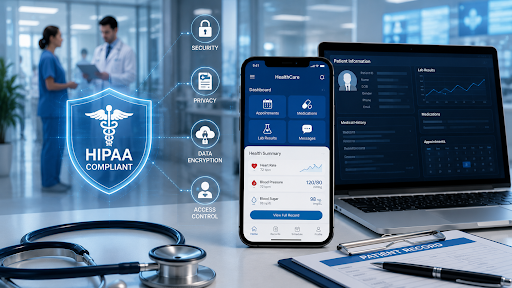
Dr. Marcus had been running a behavioral health practice in Chicago for seven years when his billing department flagged something that kept him awake for a week. A telehealth platform he’d been using to conduct video sessions and store session notes had updated its terms of service. The new terms allowed the platform to use de-identified patient data for product improvement purposes. His patients had consented to telehealth sessions. They had not specifically consented to their session content being used for anything else, and the distinction mattered under the Business Associate Agreement he’d signed with the platform. Whether the platform’s lawyers had found a legitimate interpretation or not, he didn’t want to find out during a compliance audit.
He switched platforms, tightened his vendor review process, and eventually built a custom patient communication and notes system specifically for his practice. Finding the right healthcare app development services for that project meant asking questions most development agencies hadn’t been asked before, and the agencies that could answer them well were a small subset of the broader app development market.
Here’s what HIPAA-compliant application development actually involves, and what separates teams that understand it from teams that claim to.
What HIPAA Actually Requires From a Technical Standpoint
HIPAA compliance in software isn’t a certification you receive. It’s an ongoing set of technical and administrative safeguards that govern how Protected Health Information (PHI) gets stored, transmitted, accessed, and audited. Understanding what those requirements mean for software architecture is the starting point for any healthcare application project.
Encryption is the most visible technical requirement. PHI must be encrypted at rest and in transit. In transit means TLS 1.2 or higher for all data moving between the application and its servers. At rest means database-level encryption, not just application-layer encryption, with encryption keys managed separately from the data they protect. A development team that says “we use HTTPS” as an answer to the encryption question has described roughly half of what’s required.
Access controls require role-based permission systems that limit data access to users who need it for their specific function. A billing staff member should not have access to clinical notes. A therapist should not have access to billing records from another provider’s patients. These constraints need to be enforced at the data layer, not just the UI layer, because a UI that hides a button doesn’t prevent a determined user from accessing the underlying API endpoint directly.
Audit logging means recording every access to PHI, who accessed it, when, from what location, and what they did with it, in tamper-evident logs that can be reviewed during a compliance audit. This is a backend architecture requirement that adds complexity to every data access path in the application. An application that wasn’t designed for audit logging from the start can have it added, but the retrofit is significantly more expensive than building it in.
Business Associate Agreements are required with every vendor whose service touches PHI, including cloud infrastructure providers, analytics platforms, crash reporting services, and push notification services. AWS, Google Cloud, and Microsoft Azure all offer HIPAA Business Associate Agreements. Many popular third-party services do not, which means a HIPAA-compliant application has a restricted set of available third-party integrations compared to a standard consumer app.
What Genuine Compliance Expertise Looks Like in Practice
Healthcare app development companies that genuinely understand compliance approach the project differently at the architecture stage rather than treating compliance as a layer added at the end. The data model is designed around PHI minimization from the start, collecting only the health information actually required for the application’s function. Third-party dependencies are evaluated for HIPAA BAA availability before being selected. The infrastructure configuration, encryption settings, logging configuration, network security groups, is reviewed against HIPAA technical safeguard requirements before the first user account is created.
Security testing in a HIPAA context goes beyond standard penetration testing. Threat modeling specific to healthcare data, considering attack vectors that specifically target patient data rather than generic web application attacks, produces a more relevant security assessment. Static analysis of the codebase for healthcare-specific vulnerability patterns, improper PHI handling in error messages, PHI logged in debugging output, unencrypted temporary files, is part of a rigorous security review rather than an afterthought.
Documentation is a compliance artifact in healthcare development, not just a developer convenience. The risk assessment, the system security plan, the configuration documentation, and the testing records all constitute evidence of compliance that an organization may need to produce during an audit or incident investigation.
Platform and Infrastructure Choices
HIPAA-compliant healthcare applications need to run on infrastructure covered by a signed BAA. AWS offers a substantial list of HIPAA-eligible services, including EC2, RDS, S3, and several others, covered under a standard AWS BAA. Google Cloud’s HIPAA offering covers a comparable set of services. Microsoft Azure has one of the broader HIPAA BAA coverages among major cloud providers. The specific services used in the architecture need to be on the covered list; using a non-covered AWS service to process PHI, even accidentally, is a compliance violation regardless of how secure that service is.
Database choices matter. PostgreSQL on an encrypted RDS instance is a common choice for healthcare applications because it supports the access control granularity and audit extension capabilities that HIPAA compliance requires. MongoDB Atlas has a HIPAA BAA available and suits document-oriented healthcare data models. The database configuration itself, encryption at rest settings, network isolation, backup encryption, needs to meet the technical safeguard requirements rather than just the database product being on a covered services list.
Telehealth, Mobile, and Patient-Facing Applications
Patient-facing healthcare applications carry additional considerations beyond the backend compliance requirements. Mobile apps that access HealthKit on iOS or Health Connect on Android inherit usage restrictions from those platforms that overlap with but are not identical to HIPAA requirements. Apple’s HealthKit data usage agreement prohibits using health data for advertising, which is separately a HIPAA-aligned restriction but would exist even without HIPAA.
Telehealth applications specifically need end-to-end encrypted video infrastructure. Zoom for Healthcare and Doxy.me offer BAA-eligible video platforms. Building custom video infrastructure on WebRTC requires specific attention to signaling server and TURN server configuration to ensure PHI that traverses those servers is handled under the BAA.
Consent management in patient-facing apps requires documented, specific consent for each distinct use of patient data, stored in a way that creates a defensible audit record. A generic “I agree to the terms” checkbox at onboarding doesn’t constitute the specific consent required for each data use category under a rigorous HIPAA interpretation.
What Dr. Marcus’s System Looks Like
His custom notes and patient communication system runs on HIPAA-eligible AWS infrastructure under a signed BAA. Third-party services are limited to those with available BAAs. Audit logging captures every access to patient records. Role-based access controls limit what each staff member can see based on their clinical function. Session notes are encrypted at rest at the database level.
He spent more building it than he would have spent on an off-the-shelf platform for two years. He also spent less than the average cost of a HIPAA breach investigation and remediation, which the HHS Office for Civil Rights has historically settled for between $100,000 and several million dollars depending on the nature and scale of the violation.
The calculation for a practice the size of his is genuinely close. The calculation for a healthcare organization handling tens of thousands of patient records is not.